
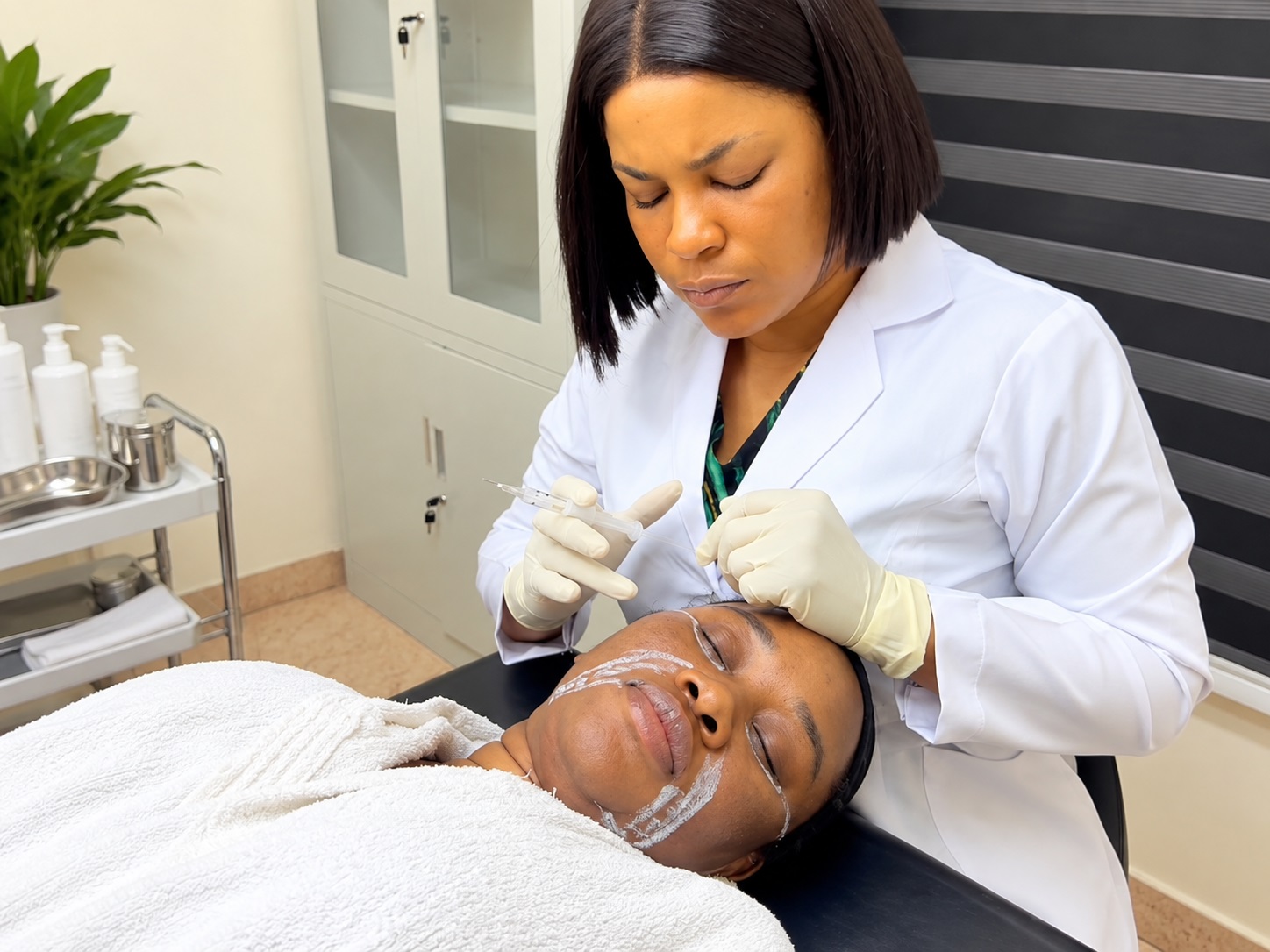
If you have been following Hadizah Eats on Instagram, you may have seen the video documenting her acne-scar revision journey. What started as a client sharing her experience quickly became a conversation of its own, with people asking questions, sharing personal experiences and, of course, giving plenty of skincare advice.
Some comments were genuinely helpful. Others came from very common misconceptions about acne, acne scars, skincare and aesthetic treatments. The conversation raised an important question: What should you actually know before starting acne-scar treatment?
So, let’s talk about it.
1. Why does acne-scar revision take multiple treatments?
This was one of the biggest reactions to Hadizah’s journey.
People saw the different treatments she had undergone and wondered: “Isn’t that too much?” or “Why can’t one treatment just fix it?”
The simple answer is that acne scars are not all the same.
Some scars are superficial. Others are deeper and affect the structure and texture of the skin. A treatment that may be appropriate for one type of scar may not be the best option for another.
Acne-scar revision is therefore often a process rather than a single appointment. Treatment may involve different procedures at different stages, with time allowed for the skin to heal and respond.
That does not mean “more treatment is always better.” It means treatment should be planned around the individual skin, scar type and response to treatment.
2. Can tretinoin remove acne scars?
One commenter suggested that Hadizah could simply use tretinoin instead of undergoing professional treatments.
This is where an important distinction comes in: acne, acne marks and acne scars are not the same thing.
Tretinoin can be useful in managing certain skin concerns, particularly acne, but established structural acne scars are a different problem. A topical product may not be enough to address changes in the skin’s texture or structure.
So, “Just use tretinoin” is not necessarily bad advice in every acne situation. The problem is treating it as a universal answer to every type of acne scar.
3. What about azelaic acid, Cosrx or other skincare products?
Another commenter suggested that tretinoin and azelaic acid could have handled the problem, while someone else recommended Cosrx, Pears oil and cloves.
The lesson here isn’t that skincare products are useless. Good home care is an important part of managing skin health.
The problem is assuming that someone else’s routine will work for your skin.
Your skin type, current condition, medical history, medications and the type of acne or scarring you have all matter. What worked wonderfully for one person may irritate another person’s skin.
Especially when dealing with significant acne or scarring, it is better to understand what you are treating before deciding what to put on it.
4. What is TCA Cross, and why wasn’t it used?
One viewer asked why they didn’t see a TCA Cross peel in Hadizah’s treatment journey.
That’s a perfectly reasonable question.
TCA Cross is one of the procedures used for certain types of acne scars, but the fact that a treatment is popular does not mean it is automatically appropriate for everyone.
This is why acne-scar treatment should begin with assessment. The important question isn’t “What is the latest scar treatment?”
It is:
“What type of scars does this person have, and what treatment is appropriate for those scars?”
Different approaches—including chemical peels, microneedling, lasers and other procedures—may have different roles depending on the individual.
5. Should everyone with severe acne take Accutane?
Another popular suggestion was essentially: “Just take Accutane.”
Accutane (isotretinoin) is a prescription acne medication, but it isn’t something that should be casually recommended in an Instagram comment.
There is also an important difference between treating active acne and treating the scars left behind by acne.
Someone may need medical treatment to control active acne, while another treatment plan may be required to address established scarring.
The right approach depends on the person’s condition and medical assessment—not simply on what worked for someone else online.
6. Is your acne really caused by poor gut health?
Someone commented that perhaps the problem was “in the gut” because gut health is important for glowing skin.
Gut health is certainly a topic worth discussing in overall health and wellness. But it is risky to look at someone’s skin and declare, “Your problem is your gut.”
Acne can have multiple contributing factors. In Hadizah’s case, she explained that she has PCOS, severe hormonal acne and a history of severe acne scarring.
That’s a good reminder that skin concerns can be more complicated than they look on a screen.
7. Are acne-scar treatments damaging the skin?
This was one of the strongest concerns in the comments.
People described the treatment journey as looking like an “experiment” or said that there appeared to be “so much damage” to the skin.
It’s understandable to have questions when you see procedures involving peels, lasers or microneedling.
But there is a difference between a controlled treatment response and actual skin damage or a complication.
Some professional treatments intentionally create a controlled response in the skin to stimulate healing and renewal. What happens afterwards can also vary depending on the procedure, skin type, treatment settings and individual healing.
That is why treatment intensity, frequency and combination should be determined by an appropriately trained professional—not copied from someone else’s journey.
8. Does laser treatment cause cancer?
One comment warned Hadizah to be careful because of cancer concerns in Nigeria.
This is an important one to clear up.
Aesthetic lasers are not the same as ionising radiation such as X-rays. They use controlled light energy for specific treatment purposes. Properly selected and appropriately used aesthetic laser treatments are not considered a cause of cancer.
However, “laser treatment” is a broad term. Different lasers have different wavelengths, settings and purposes, which is another reason to have treatment performed by a qualified professional using appropriate equipment and protocols.
Don’t let one alarming comment on social media make your medical decisions for you. Ask questions and get proper information.
9. Does acne-scar treatment have to be painful?
Apparently, quite a few people were watching Hadizah’s procedures and thinking, “I could never do this!”
Comments included concerns about pain, crying and having a low pain tolerance.
The reality is that different procedures feel different, and people’s experience of discomfort varies.
Pain should not simply be viewed as the price you pay for beauty. A professional should explain what to expect, discuss appropriate comfort measures and provide aftercare instructions.
If you are nervous, say so during your consultation. Asking questions does not make you difficult—it makes you an informed client.
10. Is acne-scar revision worth the time and money?
This may be the biggest question behind all the comments.
Acne-scar revision can require time, consistency, multiple appointments and financial investment. It is not necessarily a quick fix, and nobody should promise you a perfect result after one treatment.
But that doesn’t mean treatment is pointless.
The goal should be a realistic, professionally guided improvement based on your skin, your scars and your treatment goals.
And importantly, Hadizah’s journey is her journey. Your skin may respond differently, your treatment plan may be different and your timeline may be different.
So, What Should You Do If You Have Acne Scars?
First, don’t panic.
Second, don’t start buying every product someone recommends in a comment section.
And please don’t decide that you need tretinoin, Accutane, TCA Cross, microneedling or laser simply because somebody online said it worked for them.
Start with an assessment.
A professional should look at your skin, understand your history and determine what you’re actually dealing with before recommending a treatment plan.
Because when it comes to acne scars, there is no magic “one treatment fits everybody” button.
Sometimes the answer is skincare. Sometimes it is medical acne treatment. Sometimes professional procedures are appropriate. And sometimes it is a combination of approaches over time.
The goal isn’t to do the most treatments.
The goal is to do the right treatments for the right skin, at the right time.
And perhaps that is the biggest lesson from the conversation around Hadizah’s acne-scar journey: don’t compare your skin to somebody else’s timeline. Understand your skin first.
If you’re dealing with acne, pigmentation, uneven texture or acne scars and you’re unsure where to begin, a professional skin consultation can help you understand your options and create a more personalised treatment plan.
Your skin deserves more than random advice from the comment section.