
Let’s Talk About That Shelf in Your Bathroom
You know the one. The shelf (or drawer, or entire dedicated corner of your dressing table) packed with products you bought with full faith and high hopes. The vitamin C serum that cost you the equivalent of three good meals out. The brightening cream a friend recommended after her skin “completely transformed.” The toner, the essence, the SPF that doubles as a moisturiser because the label said so.
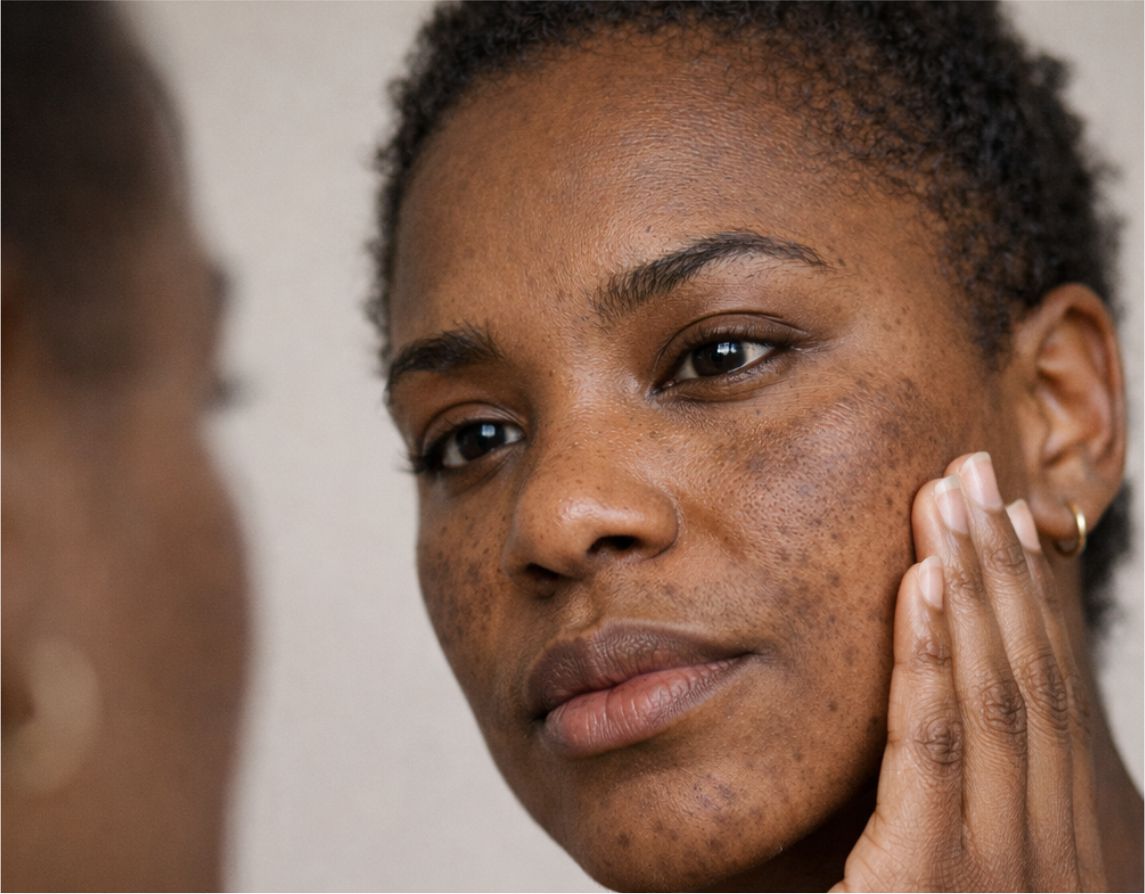
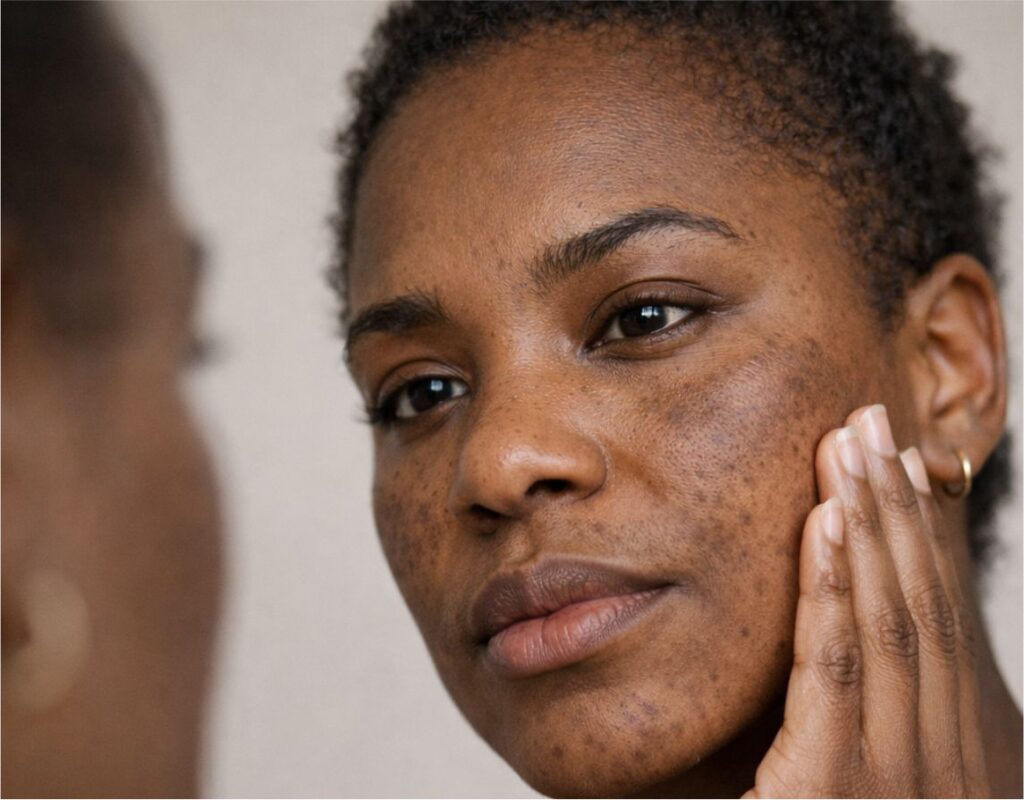
You’ve used them. Religiously. And yet, every morning you look in the mirror and your skin looks… exactly the same. Or worse, you’ve developed a new dark spot where a pimple used to be, and now that’s the thing you’re trying to fix.
If this is your story, first of all: you are not alone. Women all over Abuja are going through this exact cycle. Buy. Hope. Wait. Disappointed. Repeat. And the frustrating part is that it’s not your fault. Nobody sat you down and explained the one thing that changes everything.
So let’s do that now.
The Products Aren’t the Problem. The Mismatch Is.
Here’s an analogy that might land: imagine you have a car that runs on diesel, but everyone around you keeps recommending petrol stations. The fuel exists, the car exists, nothing is broken, but nothing works either. That’s essentially what’s happening with your skincare.
The global skincare industry, for most of its history, built its products and ran its clinical trials primarily on lighter skin tones. That means the “bestselling” serum your favourite influencer raves about was likely tested on skin that behaves very differently from yours. And what works brilliantly on one skin type can actively cause problems on another.
Here’s what makes melanin-rich skin unique: it is genuinely remarkable in many ways. It ages more slowly, has a natural resilience, and carries a richness that lighter skin simply doesn’t have. But it also has one particular trait that changes the entire skincare equation. It is significantly more reactive to inflammation.
This means that when something upsets your skin, like a pimple, a harsh ingredient, a bad reaction, even too much sun, your skin doesn’t just recover and move on quietly. It leaves a mark. A dark spot. A patch of uneven tone. Dermatologists call this post-inflammatory hyperpigmentation, but you probably just call it “this thing that won’t go away.”
That right there is why your expensive products keep disappointing you. They weren’t built with this reality in mind.
The Mistakes That Are Quietly Making Things Worse
Now let’s talk about what most of us are actually doing, with the best of intentions, that’s working against us.
Using products that are too strong, too fast. Retinoids, high percentage acids, certain vitamin C formulations. These are genuinely powerful ingredients, but introduced too quickly or at the wrong concentration on melanin-rich skin, they trigger inflammation. And as we just established, inflammation on your skin leaves a calling card. Dark spot. New problem. New product to fix it. The cycle continues.
Following routines built for someone else’s skin. A ten-step Korean skincare routine designed for someone managing redness and dryness in a cold climate is not the same thing as a routine designed for your skin in Abuja’s heat and humidity, managing hyperpigmentation and excess oil. One size has never, ever fit all.
Treating the symptom, not the source. Think of it this way: if your ceiling keeps getting a water stain and you keep repainting over it, the ceiling looks better for a week and then the stain comes back. That’s what happens when you apply brightening cream on top of a dark spot without addressing why the dark spot appeared and keeps coming back. Products work at the surface. Persistent skin concerns often have a root cause that lives deeper than any serum can reach.
Switching products every three weeks. This one hurts because it comes from a genuinely good place. You want results, you’re not seeing them fast enough, so you try something new. But skin works on its own timeline. Most corrective skincare takes a minimum of eight to twelve weeks to show meaningful change. Swapping things out constantly is like stopping an antibiotic halfway through the course and wondering why the infection came back.
Never getting a proper skin analysis. This might be the biggest one. Walking into a pharmacy and picking products based on what “sounds right” for your concerns is genuinely a bit like diagnosing yourself on Google and then prescribing your own medication. Your skin is specific. Your concerns have specific causes. And the only way to know what you’re actually working with is to have someone qualified look at it properly.
What Actually Makes a Difference
Here’s where things start to get hopeful, because this is very fixable.
Corrective skincare works when it is built around your specific skin, not a generic skin type. That means starting with an honest assessment of what’s actually going on, whether it’s active acne, stubborn pigmentation, textural concerns, or a combination of everything at once. Then it means building a protocol around that assessment using treatments and products that are appropriate for melanin-rich skin specifically.
At Doo Havilah Aesthetics, this is exactly the work we do. Our approach to corrective skincare isn’t about piling on products or chasing trends. It’s about getting to the root of what’s happening with your skin, and then treating it with the right tools, in the right sequence, at the right intensity for your skin tone and skin type.
We work with treatments that are specifically suited to darker skin tones, because we understand that what works on fair skin can backfire dramatically on melanin-rich skin. We take the time to understand your skin’s history, your lifestyle, and your goals before anything else. And then we build a plan that actually moves the needle.
The clients who see real transformation with us are not the ones who came in with the most expensive product collections. They’re the ones who decided to stop guessing and start getting answers.
Your Skin Deserves a Plan, Not Just Products
If you’ve been doing everything “right” and still not seeing results, the honest truth is that you probably haven’t had the right starting point yet. That’s not a criticism. It’s just where most people are when they first walk through our doors.
The good news is that your skin is not broken. It is not hopeless. It just needs someone to actually look at it, understand it, and give it what it needs.
If you’re ready to stop experimenting and start actually seeing change, we’d love to help. Book a consultation with us at Doo Havilah Aesthetics and let’s figure out together what your skin has been trying to tell you all along.
Your shelf deserves to hold things that actually work. And so do you.
Doo Havilah Aesthetics | Corrective Skincare | Abuja, Nigeria